


Full C-THR81-2411 Practice Test and 86 unique questions with explanations waiting just for you!
SAP Certified Associate Dumps C-THR81-2411 Exam for Full Questions - Exam Study Guide
SAP C-THR81-2411 Exam Syllabus Topics:
| Topic | Details |
|---|---|
| Topic 1 |
|
| Topic 2 |
|
| Topic 3 |
|
| Topic 4 |
|
| Topic 5 |
|
NEW QUESTION # 46
Which objects are supported in cross-entity business rules? Note: There are 2 correct answers to this question.
- A. Personal Information
- B. Work Permit Information
- C. Job Information
- D. Pay Component Recurring
Answer: C,D
NEW QUESTION # 47
The HR admin has to change the salary of an employee, which will trigger a workflow for the employee's manager. The employee's manager should be able to edit the transaction if the proposed amount is NOT correct.
Where in the workflow do you need to define this?
Refer to the screenshot to answer the question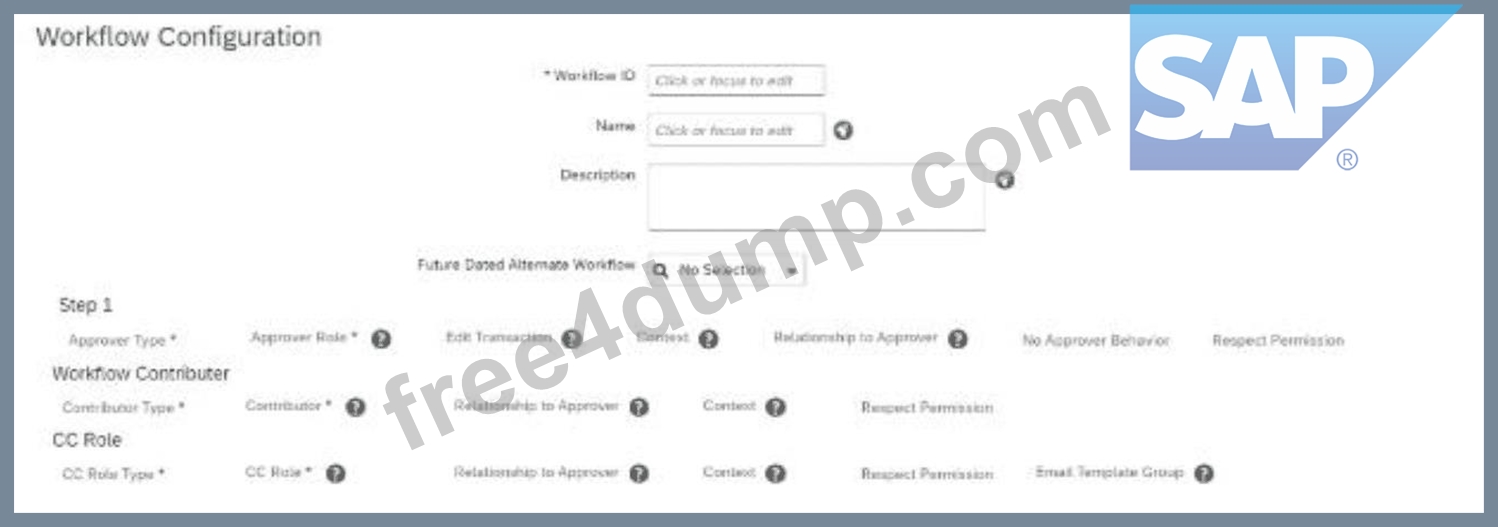
- A. No Approver Behavior
- B. Edit Transaction
- C. Respect Permission
- D. Context
Answer: B
Explanation:
To allow the employee's manager to edit a transaction in a workflow if the proposed salary change is incorrect, you must configure the"Edit Transaction"setting in the workflow.
* The"EditTransaction"option is part of the workflow configuration in Step 1 (as shown in the screenshot).
* When enabled, it allows the approver (in this case, the manager) to make adjustments to the transaction before approving it.
Scenario 2: Approvals for Self-Service
NEW QUESTION # 48
Which action will trigger a system validation for an in-progress workflow?
- A. Rehiring an inactive employee
- B. Terminating an employee
- C. Updating Job Information with the same effective date
- D. Adding a new employee
Answer: C
Explanation:
* Updating Job Information with the same effective date triggers a system validation for an in- progress workflow.
* When an in-progress workflow exists, updates to Job Information with the same effective date can cause conflicts, as the system needs to validate if the changes are permissible without interfering with the pending workflow.
* This is designed to ensure data consistency and avoid duplicate or conflicting entries.
Other options, such as rehiring, adding a new employee, or terminating an employee, are not related to triggering validations for in-progress workflows.
NEW QUESTION # 49
Which action will trigger a system validation for an in-progress workflow?
- A. Rehiring an inactive employee
- B. Terminating an employee
- C. Updating Job Information with the same effective date
- D. Adding a new employee
Answer: C
NEW QUESTION # 50
In which of the following HRIS elements do you assign workflow derivation rules for new hires?
- A. Compensation Information
- B. Biographical Information
- C. Personal Information
- D. Job Information
Answer: D
Explanation:
Workflow derivation rules for new hires are assigned in the Job Information HRIS element.
* The Job Information section contains employment-specific details and is the primary place where workflows for hiring processes are configured.
* This ensures that workflows for approvals or other processes are correctly derived and triggered during the hire action.
NEW QUESTION # 51
According to SAP guidelines, what can you do in the event picklist when configuring events and event reasons? Note: There are 3 correct answers to this question.
- A. Change the external_code of an event.
- B. Add a new language translation.
- C. Add a new event.
- D. Change the status.
- E. Change the labels.
Answer: B,D,E
NEW QUESTION # 52
The employee is changing their marital status. Once the workflow is approved, the manager gets a notification via e-mail that this change has been processed. The manager then goes into the system and checks the workflow, but notices that they can see more fields than the ones for which they should receive a notification (Name, Marital Status, and Nationality) Why is that?
- A. There is a rule that sets up the visibility for the fields in Personal Information and this applies when checking the workflow.
- B. In the workflow, Respect Permissions was set to No for the notification line to the manager.
- C. The manager has transactions pending approval permission for Personal Information.
- D. The manager's approver context is set to Source
Answer: B
Explanation:
When the manager can view more fields than they should, it is typically because in the workflow configuration, the Respect Permissions setting for the notification line to the manager was set to No. This means that the system does not enforce field-level permissions when the manager views the workflow.
Scenario 2: Approvals for Self-Service
NEW QUESTION # 53
How do you set the Event Reason Derivation rule to ensure event reasons are NOT overwritten?
- A. Set the IF statement to check if the event reason value is NOT NULL and set the THEN statement as blank.
- B. Set the IF statement to check if the event reason value is NULL and set the THEN statement as blank.
- C. Set the IF statement to check if the event reason value is blank and set the THEN statement to NULL.
- D. Set the IF statement to Always True and set the THEN statement as blank.
Answer: D
Explanation:
To ensure that event reasons are not overwritten, the business rule should be configured as follows:
* Set the IF statement to Always True: This ensures the rule is triggered every time.
* Set the THEN statement as blank: This ensures that no new event reason value overwrites the existing one.
By following this configuration, the system avoids unnecessary overwriting of existing event reason values while processing changes.
NEW QUESTION # 54
Which HRIS elements share the same People Profile block? Note: There are 2 correct answers to this question.
- A. jobinfo and organizationInfo
- B. personInfo and globalinfo
- C. personalinfo and globalinfo
- D. compInfo and payComponentRecurring
Answer: C,D
Explanation:
In SAP SuccessFactors Employee Central, the People Profile is designed to consolidate related HRIS elements into cohesive blocks for streamlined data management. Specifically, the compInfo (Compensation Information) and payComponentRecurring (Recurring Pay Components) HRIS elements share the same People Profile block. Similarly, the personalinfo (Personal Information) and globalinfo (Global Information) HRIS elements are grouped together within the People Profile. This structured grouping enhances the user experience by providing a unified view of related employee information.
NEW QUESTION # 55
How should you build the IF condition to indentify the user when the employee is updating their own Personal Information?
- A.

- B.

- C.

- D.

Answer: A
NEW QUESTION # 56
A customer has scheduled an HRIS sync job, which includes mapping of job titles, to run every Friday. On Tuesday, an employee's job title is changed via Manager Self-Service (MSS) to become effective on Thursday.
When will the synchronization happen?
- A. Friday, when the sync job completes
- B. Thursday, when the change becomes effective
- C. Tuesday, the day the transaction is entered
- D. Saturday, the day after the sync job completes
Answer: A
NEW QUESTION # 57
In which order must you assign the rules?
- A. ERD1, ERD2, ERD3, WFD, ERD-Catch
- B. ERD-Calch, ERD1, ERD2, ERD3, WFD
- C. ERD1, ERD2, ERD3, ERD-Catch, WFD
- D. WFD, ERD1, ERD2, ERD3, ERD-Catch
Answer: C
Explanation:
The rules must be assigned in the order ERD1, ERD2, ERD3, ERD-Catch, WFD for the following reasons:
* ERD1, ERD2, ERD3: These are specific rules addressing distinct scenarios or conditions in a defined sequence.
* ERD-Catch: Acts as the fallback or catch-all rule to handle any conditions not addressed by the specific ERD rules.
* WFD (Workflow-Driven): This is placed last to ensure workflow-related logic is executed after all event-related data has been validated and processed.
Scenario 1: HR Transaction Rules
NEW QUESTION # 58
Your client is live with the employee transfer process in the production instance. The workflow shown in the screenshot is triggered when an employee transfer is initiated.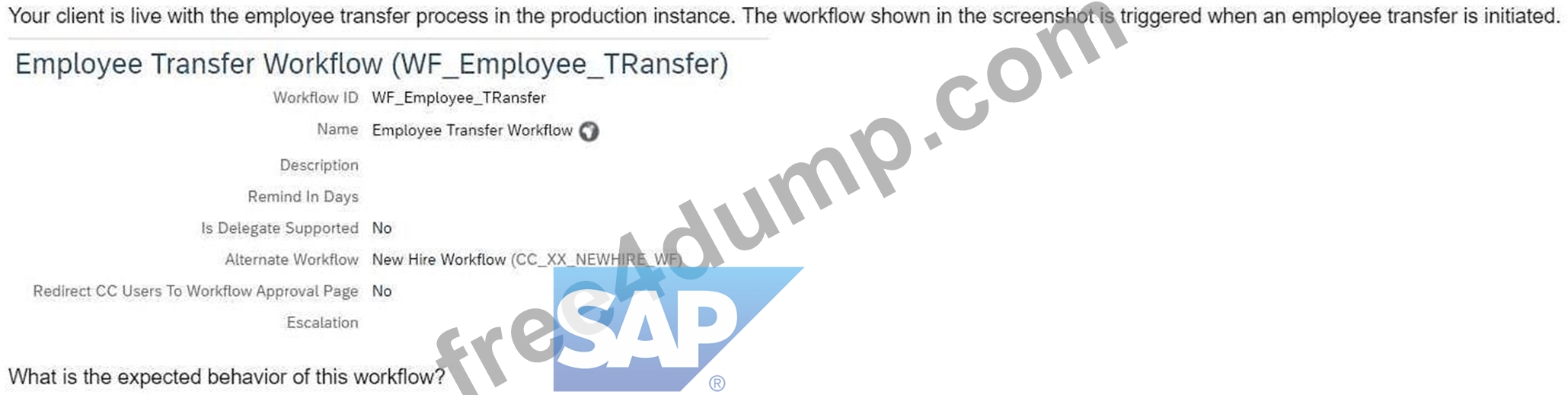
What is the expected behavior of this workflow?
- A. The alternate workflow is used when there is a future-dated record entered for the employee.
- B. An approver can automatically reroute this request to another employee during vacation.
- C. The initiator of the employee transfer process is given an option to choose New Hire Workflow as an alternate workflow toWF_Employee_Transfer.
- D. If an approver does NOT take any action for 3 days, a reminder notification is sent by the system.
Answer: A
Explanation:
In the scenario where an employee transfer process is initiated, and a workflow is triggered, the system behavior is as follows:
* Alternate Workflow Usage: If there is a future-dated record entered for the employee, the system utilizes the alternate workflow. This mechanism ensures that the appropriate workflow is applied based on the effective date of the transaction, allowing for accurate processing of future-dated changes.
This functionality is designed to handle scenarios where actions need to be taken in advance, ensuring that the system processes the correct workflow when the future-dated record becomes effective.
NEW QUESTION # 59
Which fields must be enabled for the HRIS element payComponentNonRecurring? Note: There are 3 correct answers to this question.
- A. frequency
- B. pay-date
- C. value
- D. is-target
- E. pay-component-code
Answer: B,C,E
Explanation:
In SAP SuccessFactors Employee Central, the payComponentNonRecurring HRIS element is used to record one-time payments or bonuses for employees. The following fields are mandatory and must be enabled for this element:
* A. value
* This field captures the monetary amount of the non-recurring payment.
* B. pay-component-code
* This field specifies the type of payment, such as a bonus or commission, by referencing predefined pay components.
* C. pay-date
* This field indicates the date on which the non-recurring payment is made.
These fields are essential for accurately processing and recording non-recurring payments within the system.
It's important to note that other fields like frequency and is-target are not applicable to non-recurring pay components and are therefore not required.
NEW QUESTION # 60
Which of the following can you use to explore released APIs?
- A. SAP Application Interface Framework
- B. SAP Business Accelerator Hub
- C. SAP Integration Suite
Answer: B
NEW QUESTION # 61
Where can you apply rule contexts?
Note: There are 2 correct answers to this question.
- A. onSave rules
- B. onInit rules
- C. onChange rules
- D. onView rules
Answer: A,C
Explanation:
Rule contexts in SAP SuccessFactors Employee Central can be applied in the following scenarios:
* A. onChange rules
* These rules are triggered when a field value is changed and are used to validate or calculate data dynamically.
* C. onSave rules
* These rules are executed when a record is saved, ensuring compliance with data validation or propagation requirements.
onInit rules apply during the initialization phase but are not considered part of dynamic user-triggered contexts. onView rules are not available as a configurable option in the rule engine
NEW QUESTION # 62
Manager A initiated a job code change for Employee X with an effectivity date of January 15. Another manager initiated the same request, but for January 30. What happens to the workflows triggered by both transactions?
- A. The system will cancel the second workflow.
- B. The system will reject both workflows.
- C. The system will allow both workflows to continue.
- D. The system will cancel the first workflow.
Answer: C
Explanation:
When two workflows are initiated for the same employee with different effective dates, both workflows are allowed to proceed independently. The system processes them sequentially based on their respective effective dates. This ensures that updates are recorded in the order they occur without rejecting either workflow.
Other options, such as canceling or rejecting workflows, do not align with standard system behavior for managing multiple transactions.
NEW QUESTION # 63
Which steps are required to set up the Auto Delegation feature for a workflow in Employee Central? Note: There are 2 correct answers to this question.
- A. Enable the auto-delegate permission for users.
- B. Enable the field in Succession Data Model.
- C. Enable the field in the Corporate Data Model.
- D. Define the delegate relationship in Employee Central.
Answer: A,C
NEW QUESTION # 64
Which of the following processes in Position Management are controlled from Position Management Settings?
Note: There are 3 correct answers to this question.
- A. Automated Daily Hierarchy Adaptation
- B. Follow Up Activity in Position
- C. Move Position with Supervisor on Job Information change
- D. To Be Hired Status Adaptation
- E. Synchronize Position Matrix Relationships to Job Relationships of Incumbents
Answer: A,B,D
NEW QUESTION # 65
Based on the screenshot below, can you identify any errors on the definition of the business rule to Default Position Attributes? Note: There are 2 correct answers to this question.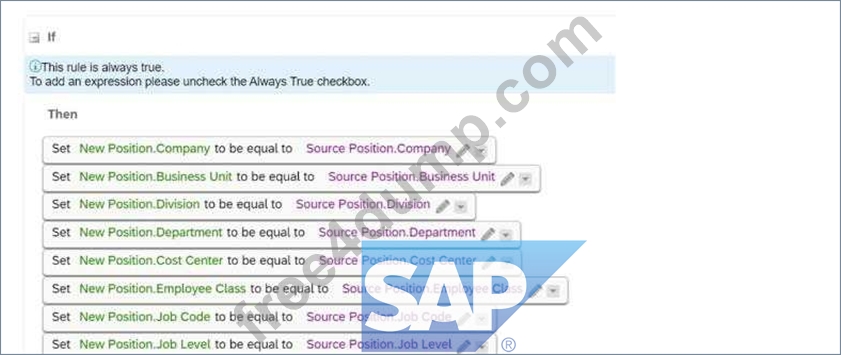
- A. The FTE field should be derived from the business rule to Calculate FTE based on Standard Hours.
- B. The workflow configuration should NOT be included in the business rule.
- C. The Company field should NOT be included in the business rule.
- D. The Parent Position field should NOT be included in the business rule.
Answer: A,D
NEW QUESTION # 66
What does SAP SuccessFactors recommend when you create custom associations between foundation objects (FO)?
- A. All custom associations should be built between an XML FO and another XML FO.
- B. All custom associations should be built as one-to-many.
- C. All custom associations should be built as one-to-one.
- D. All custom associations should be built between an MDF FO and another MDF FO.
Answer: B
NEW QUESTION # 67
The manager has the ability to change the salary during the workflow
Which of the following options do you need to select for a new workflow to be triggered when the manager edits the salary?
- A. Edit without Route Change
- B. No edit
- C. Edit with Route Change
- D. Edit Attachment Only
Answer: C
NEW QUESTION # 68
In your project, the client asks for a mechanism by which a workflow can be approved by any one of a pool of people. What tool would you use to configure the group?
- A. Manage Permission Groups
- B. Manage Workflow Requests
- C. Manage Dynamic Roles
- D. Manage Workflow Groups
Answer: D
NEW QUESTION # 69
Which condition must be used for the jobinfo_FTE_Comp rule?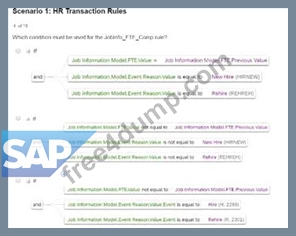
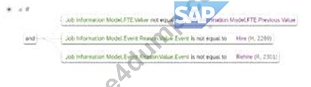
- A. Option D
- B. Option A
- C. Option B
- D. Option C
Answer: A
Explanation:
For the Jobinfo_FTE_Comp rule, the correct condition to use is Option D. This ensures that the system evaluates changes in FTE values and event reasons to calculate and adjust compensation data accordingly.
The precise conditions are necessary to maintain consistency in how the rule is applied across various HR scenarios.
Scenario 1: HR Transaction Rules
NEW QUESTION # 70
Which HRIS elements share the same People Profile block?
Note: There are 2 correct answers to this question.
- A. jobinfo and organizationInfo
- B. personInfo and globalinfo
- C. personalinfo and globalinfo
- D. compInfo and payComponentRecurring
Answer: C,D
NEW QUESTION # 71
......
Authentic Best resources for C-THR81-2411 Online Practice Exam: https://surepass.free4dump.com/C-THR81-2411-real-dump.html