


Best PPAN01 Exam Dumps for the Preparation of Latest Exam Questions
PPAN01 Actual Questions 100% Same Braindumps with Actual Exam!
Proofpoint PPAN01 Exam Syllabus Topics:
| Topic | Details |
|---|---|
| Topic 1 |
|
| Topic 2 |
|
| Topic 3 |
|
| Topic 4 |
|
| Topic 5 |
|
NEW QUESTION # 14
What are two unique benefits of submitting false positives via the support portal? (Select two.)
- A. Feedback on the false positive submission
- B. Generating a complaint to the TAP product manager
- C. Human review of the false positive claim
- D. Quick reputation check on the message contents
- E. Automatic correction to label the threat as a false positive
Answer: A,C
Explanation:
Submitting false positives through the Proofpoint support portal provides (C) human review and (D) feedback-two benefits that materially improve long-term operational quality. Human review adds expert validation beyond automated engines, which is critical when legitimate business mail is misclassified due to language patterns, new domains, unusual attachment types, or atypical sending infrastructure. The support workflow also returns feedback that helps the customer understand why the system condemned the message and what tuning steps are appropriate (policy adjustments, safe sender entries, authentication alignment, supplier allow-listing). This differs from purely local labeling, which may not propagate improvements broadly or may not be examined by Proofpoint analysts. "Automatic correction" is not guaranteed and can vary by product and configuration; support submissions are primarily a review-and-learn loop rather than an immediate auto-fix. Generating complaints is not a product feature, and "quick reputation checks" can be done within dashboards, but the support portal's value is the structured escalation path: it improves detection fidelity over time, reduces recurring business disruption, and strengthens SOC processes for handling disputes in a documented, auditable manner.
NEW QUESTION # 15
When filtering for threats on the TAP People page, which two filters have the highest chance of finding compromises? (Select two.)
- A. Users > VIP
- B. Exposure > Permitted Clicks
- C. Exposure > Delivered with Accessible Threat
- D. Threats > False Positives Only
- E. Users > Locations
Answer: B,C
Explanation:
Compromise likelihood increases sharply when users both (1) received a threat that remained accessible and (2) successfully interacted with it. "Exposure > Permitted Clicks" (A) directly indicates that a user clicked a rewritten/protected URL and the click was permitted (not blocked), which is one of the strongest leading indicators for credential theft or malware execution pathways. "Exposure > Delivered with Accessible Threat" (C) indicates delivery of a message that still contained an accessible malicious component at the time of access (e.g., URL remained reachable/uncleared), raising the chance of interaction leading to compromise. In Proofpoint IR, these two filters are used to rapidly build a "likely compromised" watchlist for immediate follow-up: validate click details, check for credential submission, correlate with suspicious logins, review mailbox rules/forwarding, and trigger post-delivery remediation (quarantine/pull) if copies remain. "Users > VIP" is important for business impact, but VIP status alone doesn't indicate compromise. "False Positives Only" reduces compromise likelihood by definition, and location filtering is contextual-not a direct compromise signal.
NEW QUESTION # 16
An analyst wants to use the Threats page in TAP Dashboard to review all messages related to a phishing campaign that contain an attachment. What is the correct method to filter these messages?
- A. Type campaign: phishing & type: attachment into the search bar.
- B. Select the Highlighted tab to review Notable Techniques.
- C. Use the threat filter to set the category, grouping, and type.
- D. Open the Impacted tab to display users exposed to a threat.
Answer: C
Explanation:
The TAP Threats page is designed for investigation by applying structured filters that constrain the dataset by threat category (e.g., phishing), grouping (e.g., campaigns), and threat type (e.g., attachment vs URL). Using the threat filter controls (A) is the most reliable, repeatable method because it leverages the dashboard's native taxonomy and ensures you are viewing only messages that meet both conditions: campaign association and attachment presence. The Impacted tab (B) is user-impact oriented and does not inherently filter to
"phishing campaign + attachment"; it is used after threats are identified to see interactions. The Highlighted tab (D) is focused on notable techniques and analyst-marked items rather than campaign scoping. While the search bar can be useful for pivots, the most "documented workflow" approach for consistent IR triage is applying the built-in threat filters, which also supports sharing consistent views across analysts and generating stable results for incident notes and reporting. This is aligned with Proofpoint IR operational practice: filter # pivot into details # scope recipients # take remediation actions.
NEW QUESTION # 17
Exhibit: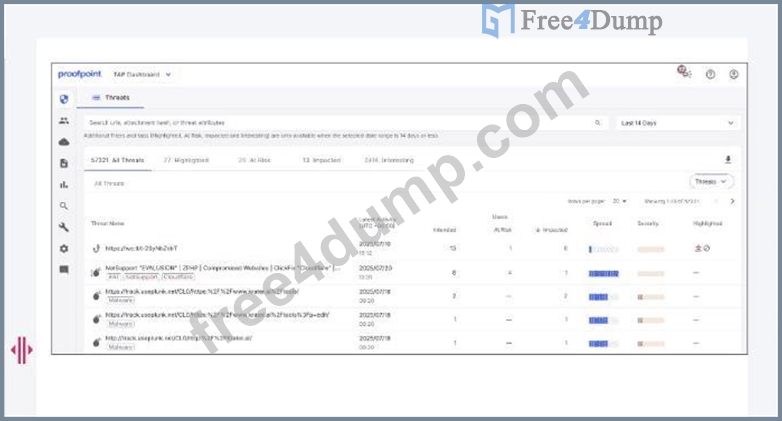
Which column indicates the number of users targeted by a malicious campaign or threat?
- A. At Risk
- B. Impacted
- C. Highlighted
- D. Intended
Answer: D
Explanation:
In TAP threat and campaign views, the columns typically reflect a funnel of exposure and interaction.
"Intended" (B) represents the number of targeted recipients-i.e., how many users the attacker attempted to reach (often including messages that were blocked or not ultimately delivered). "At Risk" usually reflects users who actually received the message (delivered) and were therefore exposed, while "Impacted" reflects users who interacted with the threat (clicks, credential entry, or other measurable engagement depending on the threat type and telemetry). "Highlighted" is a classification/flagging mechanism (not a population count of targets). For IR detection and analysis, "Intended" is crucial for estimating the campaign's scope and potential blast radius at the earliest stage-before you know how many were delivered or clicked. Analysts use Intended to decide whether to escalate, whether to run broad retroactive searches, and whether to apply preventative blocks (domains/URLs) quickly. Then they pivot to At Risk and Impacted to prioritize immediate containment actions for exposed and interacting users.
NEW QUESTION # 18
At a minimum, which three people should attend a post-incident debrief? (Select three.)
- A. Problem manager responsible for root-cause analysis
- B. MFA administrator to implement any necessary changes
- C. Security architect or CTO who is responsible for product or service redesign
- D. Human resources manager to manage the employee incident experience
- E. Incident managers and support staff that worked on this issue
- F. Users directly affected by the incident
Answer: A,C,E
Explanation:
A post-incident debrief is primarily about extracting lessons, validating timelines/decisions, and translating findings into durable engineering and process changes. The minimum effective set includes: (A) the incident managers and responders who executed the investigation and containment, because they own the factual timeline, evidence, and decision points; (C) the problem manager responsible for root-cause analysis, because they drive structured RCA (contributing factors, control gaps, "5 whys") and track corrective actions; and (D) the security architect/CTO (or equivalent design authority), because long-term remediation often requires architectural or policy redesign (email authentication enforcement, safer mail routing, TAP/TRAP automation, identity hardening, logging/retention improvements). In Proofpoint-centered incidents (phish # ATO # internal spread), durable fixes commonly require cross-system changes: DMARC alignment, safer supplier controls, stricter URL/attachment policy, and automated post-delivery remediation. HR, affected users, or MFA admins may be involved depending on the incident type, but they are not the minimum required for a technically complete debrief focused on prevention and improved response capability.
NEW QUESTION # 19
The Attack Index is a calculation of the overall threat burden for a particular user. Which listed factor contributes to this calculation?
- A. The severity and diversity of threats
- B. VIP status
- C. The user's group membership in Active Directory
- D. The number of potential attack pathways
Answer: A
Explanation:
Attack Index is intended to quantify user-centric risk by combining the severity of threats a user is exposed to and the diversity of those threats over time (D). This aligns with how IR prioritizes investigations: a user repeatedly targeted by multiple high-severity threat types (credential phishing + impostor/BEC + malware delivery) represents a higher likelihood of compromise and greater operational risk than a user receiving large volumes of low-risk spam. In Proofpoint SOC workflows, Attack Index helps drive proactive actions-focus investigations on "most attacked" users, increase monitoring, enforce stronger controls (MFA, conditional access), and deliver targeted training interventions for users with risky behavior. VIP status can be used for business-impact prioritization, but it is not the defining calculation factor for "threat burden." Active Directory group membership may be used for segmentation and reporting but is not the core metric component. The concept is to score what the user is facing in terms of threat intensity and breadth, enabling triage on the People page and supporting escalation decisions when high Attack Index correlates with clicks or delivered accessible threats.
NEW QUESTION # 20
What is the purpose of Smart Search?
- A. Trace and analyze information about files downloaded from a user's computer.
- B. Trace and analyze information about user clicks on external websites.
- C. Trace and analyze information about messages processed by the Proofpoint Protection Server.
- D. Trace and analyze information about firewall breaches.
Answer: C
Explanation:
Smart Search is a message-tracing and investigation feature used to query and analyze email messages processed by Proofpoint's email security pipeline (B). In Proofpoint-focused IR, it functions as a primary evidence source for determining whether a message was accepted, rejected, quarantined, rewritten (URL Defense), modified (banners), or delivered, and which policy/rule triggered the decision. Analysts use Smart Search to pivot on sender/recipient, subject, message IDs, attachment names/hashes, URLs, sending IPs, and disposition outcomes-supporting rapid scoping (who got it, how many, what happened) and timeline creation. This is essential for detection and analysis because it links threat intelligence (from TAP verdicts) to operational mail flow facts (gateway decisions). It is not a host forensics tool (files downloaded), a web click- tracing platform (though TAP provides click telemetry), or a network firewall analysis console. In practice, Smart Search accelerates false positive validation, identifies false negatives (delivered when it should have been blocked), and provides the authoritative audit trail needed for containment actions and post-incident reporting.
NEW QUESTION # 21
What is the first action a security analyst should take when beginning to review and prioritize alerts from Targeted Attack Protection (TAP)?
- A. Investigate false negatives by identifying root causes in source policy configurations.
- B. Use filtering options on the TAP Threats page to organize and prioritize threat alerts.
- C. Assess claims of false positives by analyzing forensic details and threat indicators.
- D. Open and examine the contents of an email using the associated .eml file.
Answer: B
Explanation:
The first step in a scalable TAP-driven workflow is to reduce the alert set into an actionable queue using built- in filtering on the Threats page (time range, severity, threat type, campaign grouping, Intended/At Risk
/Impacted, VIP targeting, and "Highlighted" categories). This aligns with SOC operational procedures: triage is a funnel, and TAP's dashboards are optimized for sorting by risk and user impact so analysts can quickly identify what is most likely to represent an active incident. Jumping straight into .eml review or false-positive adjudication is inefficient before you know which threats have user interaction (clicks), broad distribution, or high severity. Likewise, false-negative root cause analysis is a later-stage improvement activity, typically triggered after an incident or quality review. In Proofpoint IR practice, you filter first to find: (1) threats with
"Impacted" users (clicks/interaction), (2) high severity (credential theft/malware), (3) VIP targeting, and (4) campaign clusters. Only then do you pivot into forensic details, message artifacts, URL/attachment detonation results, and-if necessary-remediation actions (blocklists, TRAP pulls, user resets).
NEW QUESTION # 22
Based on the exhibit,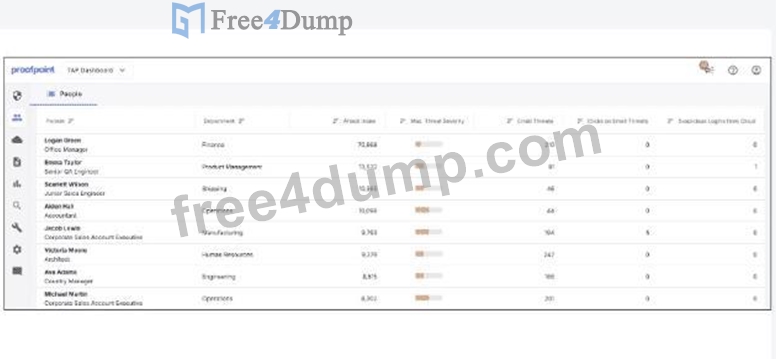
which user would most benefit from attending security awareness training based on their behavior?
- A. Scarlett Wilson
- B. Jacob Lewis
- C. Logan Green
- D. Emma Taylor
Answer: B
Explanation:
In Proofpoint user-risk views (People page / user lists), "behavior" signals that drive training prioritization typically include measurable interaction with threats-especially clicks on email threats and repeated exposure patterns. The exhibit indicates that Jacob Lewis stands out behaviorally (e.g., elevated "Clicks on Email Threats" relative to peers and/or meaningful exposure indicators), making them the best candidate for targeted awareness intervention. From an IR preparation standpoint, training is most effective when it is risk- based and individualized: users who click are statistically more likely to become the initial foothold for credential theft and account takeover. Proofpoint programs commonly combine technical controls (URL Defense blocking, attachment detonation, post-delivery quarantine) with human controls (just-in-time coaching, targeted modules, reinforcement after real-world reports). Assigning training to high-click users reduces future incident volume by cutting successful phishing rates, improving reporting via "Report Suspicious," and increasing early detection. Operationally, analysts also pair training with compensating controls for repeat clickers (stricter URL access policy, heightened monitoring, enforced MFA, mailbox rule audits) to reduce risk while behavior improves.
NEW QUESTION # 23
Which scenario would prevent URL Defense from rewriting a URL?
- A. The email was not flagged as malicious.
- B. The URL is contained in a PDF attachment.
- C. The user has clicked the URL before.
- D. The URL is hosted on a secure HTTPS domain.
Answer: B
Explanation:
URL Defense rewriting primarily targets URLs in the email body where Proofpoint can transform the link into a protected, time-of-click analyzed URL. If the URL is embedded inside a PDF attachment (A), it generally cannot be rewritten the same way because it is not a standard hyperlink in the email body; it's content inside an attached document. While Proofpoint can still analyze attachments and may extract URLs for analysis depending on configuration and capabilities, the classic "rewrite" mechanism is for body URLs, not attachment-contained links. Previous clicks (B) do not prevent rewriting; rewriting occurs at delivery
/processing time. HTTPS hosting (C) does not prevent rewriting; URL Defense supports HTTPS destinations.
Whether the email is flagged malicious (D) is not the gating factor for rewriting-rewriting is typically policy- driven (rewrite or not rewrite) to enable time-of-click protection even for URLs that appear benign at delivery. In IR, this distinction matters: phishing in PDFs often requires layered controls (attachment sandboxing, file analysis, and user coaching) because URL rewriting visibility may be reduced.
NEW QUESTION # 24
Which TAP Reports tab provides a view of the distribution of threats against your organization, including quantity of messages, variation of threat campaigns seen, and the number of individual threats that weren't part of a campaign?
- A. Effectiveness
- B. Objectives
- C. Landscape
- D. Organization
Answer: C
Explanation:
The "Landscape" report (A) is designed to summarize the overall threat distribution against the organization- how much malicious mail is being seen, what categories dominate (phish/malware/impostor), how many distinct campaigns are active, and how many threats appear as one-offs (not clustered into campaigns). In Proofpoint-driven detection and analysis, this view supports strategic triage and posture assessment: it helps a SOC understand whether they are facing broad commodity spam/phishing, a few concentrated campaigns, or many unique targeted attacks. It also informs resource planning (analyst workload), control tuning (URL
/attachment policies), and targeted mitigations (blocklists, stricter policies for high-risk groups).
"Effectiveness" typically focuses on outcomes (blocked vs delivered, prevented clicks, remediation success),
"Objectives" aligns to attacker goals (credential theft, malware delivery, BEC), and "Organization" is commonly more about organizational breakdowns (departments, user groups, VIPs). For incident response planning, the Landscape tab provides the "what are we facing overall" context that helps prioritize prevention initiatives and define detection coverage gaps.
NEW QUESTION # 25
What type of threat does the Cloud Security Report help identify in connected environments?
- A. Business Email Compromise
- B. Ransomware
- C. Account Takeover
- D. Malicious Insider
Answer: C
Explanation:
The Cloud Security Report is designed to highlight risks and suspicious activity across connected cloud environments, with a strong focus on indicators consistent with account takeover (ATO) (B). In Proofpoint cloud-connected contexts (e.g., cloud email and SaaS integrations), ATO manifests through patterns such as unusual sign-in behavior, suspicious mailbox activity, anomalous sending, unexpected forwarding rules, OAuth application consents, and risky access from new locations/devices. For IR, this is critical because modern phishing frequently targets credentials and sessions rather than delivering executable malware, and compromised cloud identities enable fast lateral movement through internal phishing, invoice fraud, and data access. Proofpoint reporting helps analysts identify which users and accounts show the strongest compromise signals so they can prioritize containment: force password reset, revoke refresh tokens/sessions, remove malicious inbox rules and forwarding, disable suspicious OAuth grants, and validate MFA posture. While ransomware, insider risk, and BEC can be related outcomes, the Cloud Security Report's connected- environment emphasis is on identity compromise signals and cloud account misuse-core ATO detection and investigation drivers.
NEW QUESTION # 26
Which two tasks are considered frequent and high-priority when actively reviewing the threat landscape?
(Select two.)
- A. Scheduling annual penetration tests for system validation.
- B. Reviewing monitoring data to inform risk-based decisions.
- C. Updating user training materials for quarterly phishing simulations.
- D. Monitoring current threats and vulnerabilities affecting systems.
- E. Archiving historical incident reports for long-term compliance.
Answer: B,D
Explanation:
Active threat landscape review is an operational detection-and-analysis function: it focuses on what is happening now, what is likely to impact the environment, and what telemetry indicates elevated risk.
Monitoring current threats and vulnerabilities (C) keeps analysts aligned to emergent campaigns (new phishing kits, BEC lures, malware droppers, supplier compromise patterns) and to exposure shifts (fresh CVEs that enable email-to-endpoint execution chains, new MFA-bypass trends, OAuth consent abuse).
Reviewing monitoring data for risk-based decisions (E) is the day-to-day SOC activity that converts signals into priorities: TAP Threats/People views (Intended/At Risk/Impacted, clicks, severity), message traces (Smart Search), and threat response outcomes (quarantines/pulls). These two tasks directly reduce time-to- detect and time-to-contain by ensuring analysts focus on threats with user interaction, VIP targeting, and campaign spread. The other options are valuable but not "frequent and high-priority" in active landscape review: training content updates are periodic program work, pen tests are annual/episodic, and archiving is compliance-driven rather than real-time threat prioritization.
NEW QUESTION # 27
As an information protection security analyst, what should you do to ensure that escalation documentation is up to date?
- A. Initiate updates to escalation documentation when there are personnel or role changes that affect communications paths.
- B. Make sure the escalation documentation is based on department-level contacts and allows you to ignore personnel or role changes.
- C. Only review escalation documentation when there are major incidents and all needed personnel are available for review.
- D. Wait for official notification of personnel changes from Human Resources to update the escalation documentation.
Answer: A
Explanation:
Escalation paths are operational safety rails: they ensure the right stakeholders can be reached quickly under time pressure (e.g., suspected account takeover, executive impersonation, data loss). The correct practice is to update escalation documentation whenever people or roles change in ways that affect communication paths (D). In Proofpoint-centric IR, the "who do we contact" question is time-critical because containment actions may require identity admins (account disable/reset/token revocation), email admins (transport rules, allow
/block changes, TRAP pulls), legal/privacy (breach assessment), and business owners (wire-transfer verification). Waiting for HR (A) introduces delay and gaps; relying only on department-level contacts while
"ignoring" role changes (B) is risky because specific authorities are needed (e.g., the person who can approve emergency mailbox search or enforce MFA). Reviewing only during major incidents (C) fails because the first time you discover stale contacts is the worst time. Best practice is a living escalation matrix tied to on- call rotations, role-based distribution lists, and tested quarterly via tabletop drills, ensuring Proofpoint remediation and comms steps can be executed without bottlenecks.
NEW QUESTION # 28
What does a notification of "Cleared" mean when shown in the header of an individual threat tab?
- A. The threat has been temporarily contained but may still pose a risk.
- B. The threat has been successfully neutralized and no longer poses a risk.
- C. The threat has been identified but is not considered a priority for investigation.
- D. The threat has been detected but hasn't been resolved yet.
Answer: B
Explanation:
In Proofpoint TAP/Threat Protection Workbench-style workflows, "Cleared" indicates the threat is no longer considered active or dangerous in the environment. This status is used after Proofpoint systems (and/or analyst actions) determine that the malicious component is neutralized-commonly because URLs are now blocked, the threat has been remediated post-delivery (pulled/quarantined), or further analysis reclassified the item as safe. In containment terms, "Cleared" communicates that the immediate risk has been reduced: users should not be able to access the malicious URL through URL Defense, and attachment-based threats may have been condemned and/or removed from mailboxes where applicable. IR teams still use the cleared state as a pivot point: they confirm whether any users were already impacted (clicks/credential entry), validate that remediation actions succeeded across all intended mailboxes (no "unavailable" gaps), and ensure preventive controls are in place (custom blocklists, authentication enforcement, banner rules, supplier controls).
"Cleared" is not the same as "not important"; it means the threat no longer poses an ongoing hazard, but scoping and user follow-up may still be required.
NEW QUESTION # 29
An analyst is reviewing the Notable Senders section in Proofpoint Supplier Threat Protection.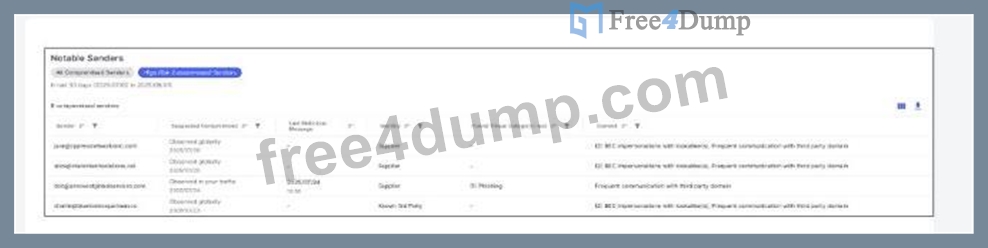
Based on the data shown in the exhibit, which vendor's email activity should be investigated first?
Answer: B
Explanation:
Supplier Threat Protection prioritization focuses on vendor identities whose messaging patterns indicate elevated risk-such as unusual sending behavior, higher malicious/suspicious message counts, abnormal spike patterns, or stronger impersonation/compromise indicators relative to other suppliers. Based on the exhibit's Notable Senders metrics, [email protected] (C) shows the highest-risk activity and should be investigated first. In Proofpoint IR workflow, supplier-related threats are high impact because they exploit trust relationships and can bypass user suspicion (invoice/payment workflows, shared documents, ongoing threads). The investigation typically validates whether this is: (1) a compromised supplier mailbox, (2) supplier-domain impersonation (lookalike domain), or (3) a legitimate supplier system misconfigured and sending risky content. Analysts pivot into message samples, authentication alignment (SPF/DKIM/DMARC), sending infrastructure changes, and recipient targeting patterns (finance/AP, executives). If malicious, containment includes blocking the supplier sender/domain (or precise subdomains), pulling delivered copies via TRAP, alerting impacted users, and initiating vendor contact to remediate the supplier's account security.
NEW QUESTION # 30
Which of the following is an item that should be included in an incident report as part of the post-incident debrief?
- A. Proofpoint threat landscape reporting
- B. Adversary tactics and techniques
- C. Incident response plan
- D. Network diagrams
Answer: B
Explanation:
A high-quality incident report captures what the adversary did in a way that enables prevention and detection improvements. Including adversary tactics and techniques (C) is essential because it translates raw artifacts (emails, URLs, headers, click events) into actionable security engineering outcomes: which initial access method was used (credential phishing vs BEC), which impersonation technique (display name, lookalike domain, supplier compromise), what persistence was attempted (mailbox rules/forwarding, OAuth consent), and what objectives were pursued (invoice fraud, data theft, lateral phishing). In Proofpoint-centered IR, mapping tactics and techniques supports targeted control tuning: URL Defense policy, attachment sandboxing, impostor rules, DMARC enforcement, and TRAP automation; it also improves analyst playbooks (what pivots to run next time, what indicators to hunt). The incident response plan (B) is a reference document, not an incident-specific report item. Network diagrams (A) may be helpful in some incidents but are not always relevant for email-led events. Threat landscape reporting (D) is contextual intel, but the report must focus on what occurred in this incident and what to change to reduce recurrence, which is best captured via tactics/techniques.
NEW QUESTION # 31
An analyst is reviewing a quarantined threat within Threat Protection Workbench.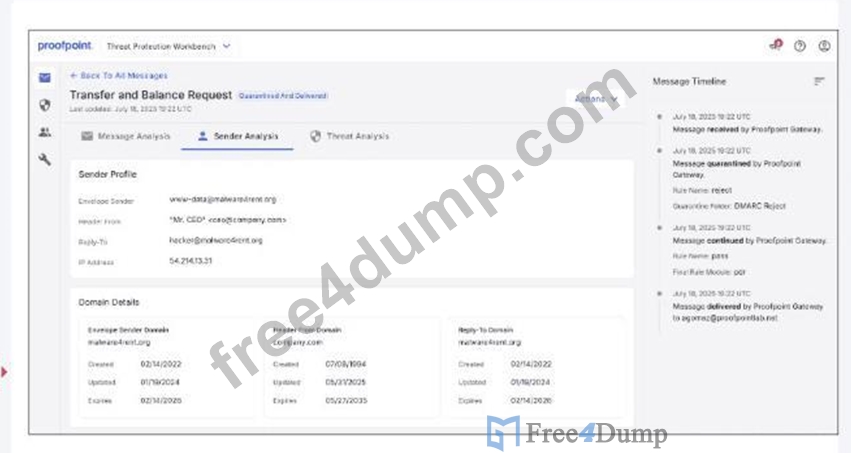
Based on the indicators shown in the exhibit, what is the most likely reason the threat was quarantined?
- A. The threat was quarantined because there is a sender impersonation risk.
- B. The threat was quarantined because it contained malware.
- C. The threat was quarantined because it is from a known malicious IP address.
- D. The threat was quarantined because it is from a newly created domain.
Answer: A
Explanation:
Threat Protection Workbench quarantine decisions are often driven by high-confidence "people-centric" risk signals, especially impersonation/impostor detections. The indicators in the exhibit point to sender identity risk (display-name mismatch, lookalike/brand impersonation cues, or authentication/alignment anomalies that elevate "impostor" confidence), which aligns with sender impersonation quarantine (B). In Proofpoint IR practice, impersonation is treated as high priority because it maps directly to BEC and credential theft outcomes and can be "clean" from a malware/URL perspective (text-only lures, invoice/payment requests).
While malware, newly registered domains, and known malicious IPs can also drive quarantine, Workbench presentations for supplier/impostor often explicitly surface impersonation risk scoring and "who is being impersonated" context, which is the decisive factor for this scenario. Operationally, analysts respond by validating authentication results (SPF/DKIM/DMARC alignment), checking sender domain similarity/age, reviewing conversation history anomalies, and scoping for additional recipients. Containment frequently includes blocking the lookalike domain/sender, pulling delivered copies with TRAP, and notifying targeted business units (finance, executives) to prevent fraudulent actions.
NEW QUESTION # 32
Which filter category in the TAP Dashboard helps identify threats targeting VIPs or specific geographies?
- A. Targeted
- B. At Risk
- C. Impacted
- D. Highlighted
Answer: A
Explanation:
The "Targeted" category (B) is used to surface threats that show targeting characteristics-commonly including VIP-focused campaigns, department/role targeting, and sometimes geography-linked targeting indicators depending on available telemetry and configuration. In Proofpoint triage, "At Risk" and
"Impacted" are exposure/interaction oriented (who received, who interacted/clicked), while "Highlighted" typically flags notable techniques or analyst-marked items (e.g., suspicious/interesting, false positive indicators, notable patterns). "Targeted" is the fastest way for analysts to focus on high-consequence threats because VIPs and specific geographies often correlate with executive impersonation, wire-fraud pretexting, supplier fraud, or regionally themed campaigns. Operationally, this filter supports a risk-based IR queue:
targeted threats are escalated earlier, scoped wider (adjacent executives/assistants, finance users, supplier comms), and handled with more aggressive containment (blocking infrastructure, retroactive pulls, identity checks). It also supports proactive defense: targeted patterns can trigger tighter policies for high-risk cohorts (VIP protections, stricter URL access, enhanced bannering, and stricter authentication handling).
NEW QUESTION # 33
......
PPAN01 Study Material, Preparation Guide and PDF Download: https://surepass.free4dump.com/PPAN01-real-dump.html